Swing Security Gates: Traditional & Reliable
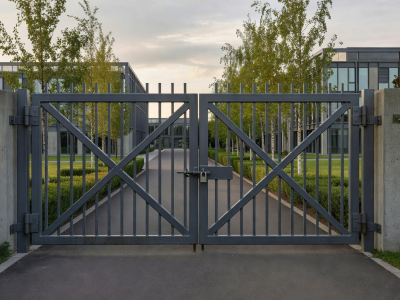
Swing gates are the traditional staple of perimeter security. Operating on hinges mounted to robust posts or pillars, they open similarly to a standard door. While often specified for their classic aesthetic appeal—particularly in corporate headquarters and residential developments—modern swing gates are engineered for high-security applications, providing an imposing physical barrier.
Single vs. Double Leaf Configurations
The choice between a single gate (one large moving panel) and a double leaf gate (two panels meeting in the middle) largely depends on the width of the driveway and the space available for the gate to swing into.
Single Leaf Gates: Best suited for narrower driveways (typically up to 4 or 5 meters). They require only one automation motor, which simplifies installation and maintenance. However, they need a significant amount of clear space to swing open and place high stress on a single hinge post, requiring deeper foundations.
Double Leaf Gates: The standard for wider commercial entrances. By splitting the span, each leaf is shorter, reducing the swinging arc and the spatial footprint required inside the property. They distribute the load across two posts but require two sets of motors and control synchronization.
Spatial Requirements and Incline Challenges
The most critical factor when specifying a swing gate is assessing the ground level within the sweeping arc of the gate leaves. Swing gates must remain level; they cannot swing open over rising ground unless special, complex rising hinges are employed (which are generally not recommended for heavy security gates due to wear and tear). If the driveway slopes upward into the property, the gates must be configured to open outward, which is often prohibited by local highways regulations if they open onto a public pavement or road.
Wind Loading: A Critical Factor
Swing gates act like large sails when closed, making them highly susceptible to wind loading. A solid infill (like timber or sheet steel) will catch the wind, placing immense strain on the hinges, the motors, and the locking mechanisms. In exposed areas or sites prone to high winds, an open infill design—such as vertical steel bars, palisade, or open mesh—is strongly advised to allow wind to pass through, ensuring the automation system can operate without stalling.
Automation Methods
Automating a heavy security swing gate requires powerful mechanisms. There are two primary types of operators used in commercial settings:
- Articulated/Linear Ram Arms: Mounted visibly on the back of the gate and the post. These push and pull the gate open and closed. Hydraulic rams are typically preferred for heavy, high-cycle security gates due to their immense power and durability compared to electromechanical equivalents.
- Underground Motors: Housed in foundation boxes sunk into the ground directly beneath the hinge point. These offer a cleaner aesthetic as the mechanisms are hidden, making them popular for high-end corporate sites. However, they require extensive groundworks, excellent drainage to prevent the boxes from flooding, and are generally more expensive to install and maintain.
Locking and Security Integration
For a swing gate to be truly secure, reliance on the automation motors alone to hold the gate closed is insufficient. A physical locking mechanism is required to prevent the gate from being forced open. Magnetic locks (maglocks) providing hundreds of kilograms of holding force are commonly used, seamlessly integrated with the gate's control panel and the site's overall access control system (e.g., RFID card readers or intercoms).