Pedestrian Turnstiles: Managed Access Control
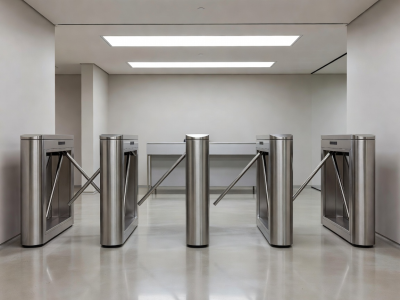
While large automated gates handle vehicular traffic, securing the perimeter against unauthorized pedestrian access requires a different approach. Turnstiles enforce a single-file, measured entry process, ensuring that every individual passing into a facility is authenticated. They are the ultimate solution against pedestrian tailgating and provide accurate data for time, attendance, and emergency roll-call systems.
Full-Height Turnstiles
Full-height turnstiles provide the highest level of physical perimeter security for pedestrians. Operating much like a revolving door made of interlocking steel bars, they are impenetrable without authorization.
- Applications: Perimeter fence lines, unstaffed entrances, construction sites, manufacturing plants, and stadiums.
- Design: Constructed typically from heavy-duty galvanized or stainless steel to withstand severe weather and vandalism. They feature a central rotating pillar with three or four sets of arms (rotors) that mesh with a fixed cage.
- Security: They make it physically impossible for someone to jump over or crawl under the barrier. When locked, the rotor cannot be forced; upon a valid credential read, the mechanism unlocks just enough to allow one rotation—one person—before relocking.
Waist-Height Turnstiles (Tripods)
Waist-height or tripod turnstiles are the most common form of pedestrian access control found in supervised indoor environments. They present a physical barrier but rely partly on the presence of reception staff or security personnel, as a determined intruder could theoretically jump over them.
- Applications: Office building lobbies, leisure centers, transport hubs, and employee entrances.
- Operation: They feature three arms extending from a rotating drum. A valid pass drops a solenoid lock, allowing the user to push the arm and walk through. The mechanism then advances to present the next arm and locks.
- Drop-Arm Feature: For emergency egress, modern tripods feature a drop-arm function. In the event of a fire alarm or power failure, the active arm drops out of the way, creating an unobstructed path for rapid evacuation.
Optical and Speed Gates
A step up aesthetically from tripods, optical turnstiles (or pedestrian speed gates) use glass or acrylic wings that retract or swing open. They employ complex arrays of infrared sensors to track the pedestrian's passage.
These units are designed for high-end corporate environments where aesthetics are as important as security. The sensors can detect tailgating (two people attempting to pass on one credential) and sound an alarm. They allow for faster throughput than tripods and easily accommodate wide lanes for wheelchair access or goods delivery.
Integration with Access Control
Turnstiles act as the physical enforcement arm of an electronic access control system. They are hardware-agnostic, meaning they can be integrated with almost any credential reading technology:
- RFID and Smart Cards (Mifare, DESFire)
- Biometric scanners (fingerprint, facial recognition)
- QR code and barcode readers (for visitor management)
- Smartphone Bluetooth/NFC credentials
This integration ensures that security managers have a precise, real-time log of who is on-site at any given moment, which is vital for both security auditing and health and safety compliance.