Sliding Security Gates: Comprehensive Guide
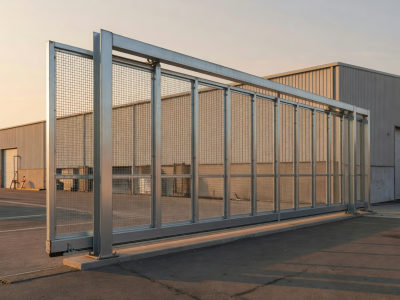
When securing wide commercial and industrial driveways, sliding security gates are often the primary choice. Unlike swing gates, which require a significant arc of clear space to operate, sliding gates run parallel to the fence line. This space-saving design is highly efficient for properties where internal space is at a premium or where the driveway sits on an incline that would impede a swinging leaf.
Tracked vs. Cantilever Systems
The fundamental decision when specifying a sliding gate is choosing between a tracked system and a cantilever system. Each has distinct mechanical principles and site requirements.
Tracked Sliding Gates
Tracked gates feature wheels mounted to the bottom of the gate frame, which run along a steel rail embedded in the ground across the driveway opening. This traditional design is capable of spanning massive widths and supporting heavy, high-security infills.
- Pros: Can cover very wide openings; lower profile side run-back required compared to cantilever; highly stable against wind loading.
- Cons: The track must be kept clear of debris, snow, and ice to function correctly; requires a completely level ground across the opening; installation involves significant groundworks to embed the track securely.
Cantilever Sliding Gates
Cantilever gates do not use a ground track across the opening. Instead, the gate is supported by a robust roller carriage system mounted to a concrete foundation set to one side of the driveway. The gate panel is extended (the "tail" or cantilever section) so that it remains balanced and supported while suspended over the driveway.
- Pros: Unaffected by ground debris or snow; ideal for uneven ground or block-paved surfaces where laying a track is undesirable; smoother, quieter operation with less ongoing track maintenance.
- Cons: Requires a larger overall gate length (typically 30-40% longer than the opening) to accommodate the counterbalance tail, necessitating a longer run-back area along the fence line.
Construction Materials and Infill
Security gates must present a formidable physical barrier. The primary frame is typically constructed from heavy-duty galvanized steel, chosen for its strength and resistance to corrosion. Depending on the aesthetic and security requirements, the infill can vary widely:
Palisade or vertical bar infills are common in industrial settings, offering high visibility combined with strong anti-climb properties. For sites requiring privacy or higher security, solid steel sheeting or dense architectural mesh (such as 358 prison mesh) can be utilized. All metalwork should be galvanized and often powder-coated to match corporate colors and provide a secondary layer of weather protection.
Automation and Safety Compliance
Automating a sliding gate introduces significant kinetic energy. Safety is paramount and highly regulated. Automation systems consist of a rack-and-pinion drive mechanism powered by a heavy-duty electromechanical motor.
To comply with modern machinery directives and safety standards, automated sliding gates must be fitted with comprehensive safety features:
- Resistive Safety Edges: Rubber profiles fitted to the leading edge and stanchions. If compressed by contact with an object or person, they instantly halt and reverse the motor.
- Photocells: Infrared beams projected across the opening. If the beam is broken, the gate will not close, preventing crushing.
- Flashing Warning Lights: To visually indicate when the gate is in motion.
Maintenance Considerations
Regular maintenance is essential to ensure the longevity and reliable operation of a sliding security gate. Tracked gates require frequent sweeping of the floor rail. The rack and pinion drive must be kept clean and properly lubricated, while the electrical enclosures should be inspected annually to prevent water ingress and insect infestation. Preventative maintenance contracts are highly recommended for any commercial installation to minimize downtime and ensure continuous site security.